Luang Prabang is a city in northern Lao PDR, with a remarkably well-preserved historic townscape that was inscribed as UNESCO World Heritage in 1995 and is one of the leading tourist attractions in the country. Luang Prabang is in transition, with several regionally significant projects reshaping the urban structures within and around the city. These projects include the Lao-China Railway, which became operational in December 2021, and planned projects such as an expressway from Vientiane to China, a new bridge across the Mekong River connecting Luang Prabang and Chompet, and the Luang Prabang Special Economic Zone (LPSEZ). Collectively, these projects may influence land use and development patterns, mobility patterns, and the number of visitors to Luang Prabang.
The historic city of Luang Prabang is facing critical urban challenges amid unprecedented development pressures on the urban center and periphery, with continuous increases in population, tourists, and economic activities. Limited mobility options and traffic management encourage motorbikes and driving, creating problems such as traffic congestion, illegal parking, and road safety issues. Significant population and tourism growth, as well as new land developments, result in increased demand for travel and strain on the existing system, exacerbating transport problems.
In this context, Luang Prabang urgently needs to build the capacity of key actors engaging in urban transport. It is also critical for Luang Prabang to formulate a transport master plan that guides the future of the transport systems and traffic management, enabling it to continue to grow sustainably as a center of tourism with cultural heritage while also meeting the mobility needs of local residents and workers. With this background, JICA provides technical cooperation to enhance their capacity in urban transport.
Phnom Penh, the capital of Cambodia, is the country’s political and economic center. Because of recent economic development, the population is expected to increase to approximately 2.62 million people in 2035, and the number of newly registered vehicles in the country has doubled in less than ten years, from 282,000 in 2013 to 506,000 in 2021. The average travel speed on major roads was 14.4 km/h in 2022, indicating no fundamental improvement compared to 14.6 km/h in 2012. The bus operating speed was reported to be 13.1 km/h on average in 2019, which is even slower than that of general vehicles, and traffic congestion is becoming more severe with the automobile-centered transportation system.
JICA has been continuously supporting the formulation and revision of the Phnom Penh Urban Transport Master Plan (PPUTMP) and has implemented technical cooperation related to the provision of buses, the installation of traffic lights, and capacity building for public bus operations and the traffic control center, in line with PPUTMP. Although efforts to alleviate congestion have progressed to some extent, they have not been realized in the public transport sector. Furthermore, the current situation has not yet led to behavioral changes among citizens, such as a shift from private to public transport. Moreover, changes in the urban transport environment have been observed in recent years, including the rapid spread of app-based ride-hailing services as a new means of transport.
In light of these issues, and to address further challenges in urban transport in the future, JICA assists the Phnom Penh Metropolitan Administration (PPCA) in strengthening its capacity to revise the urban transport master plan with a long-term urban development vision in collaboration with other relevant organizations and to proceed with comprehensive urban transport planning, management, and coordination.
Namibia, located on the Atlantic coast of southern Africa, has a natural good harbor called Walvis Bay and international corridors that connect it to neighboring countries, giving it great potential as a logistics route. From 2011 to 2024, IDCJ worked consistently with JICA on economic development and logistics promotion as part of Namibia’s national targets.
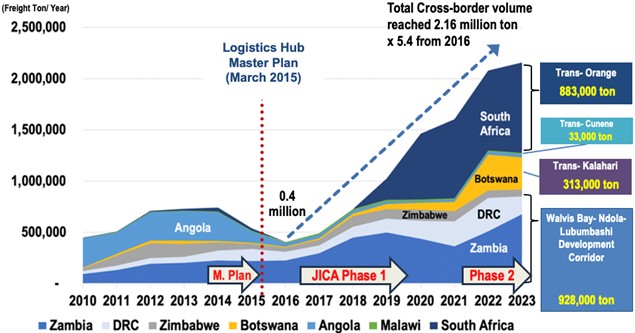
First, IDCJ proposed the Vision “Country of an international logistics hub” in the 2011 study, which was incorporated as a priority in the Namibia’s National Development Plan 4, setting the goal of making Namibia an international logistics hub in the Southern African Development Community by 2025. The subsequent project on the International Logistics Hub Master Plan envisioned a scenario of capturing transit logistics demand for landlocked countries such as Zambia, and proposed the key actions including attracting international logistics company’s operation bases, upgrading the transportation network, and introducing integrated border management.
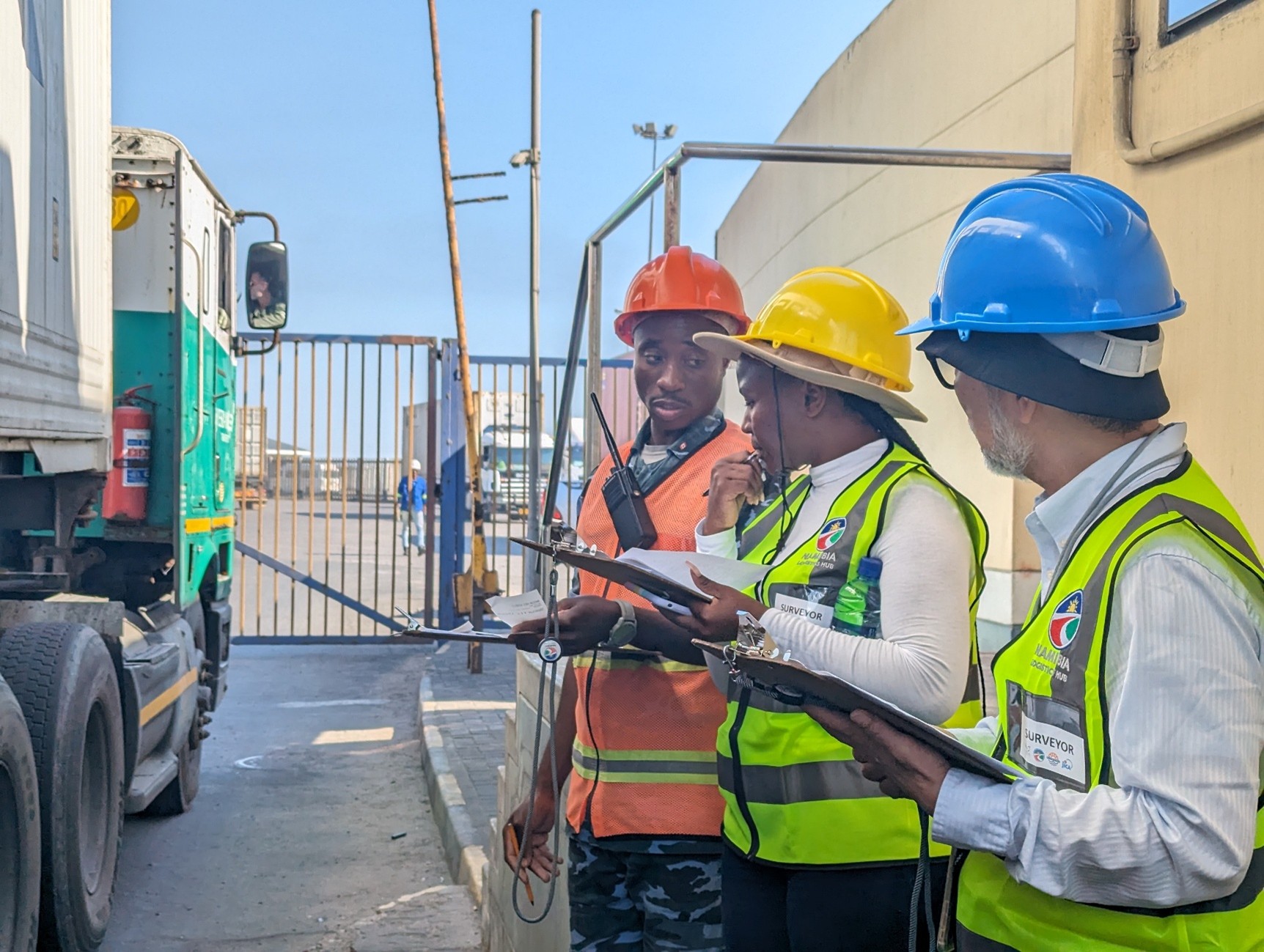
In response, the Namibian government established working groups (WG) for (1) Logistics Hub Center, (2) Strategic Marketing, (3) Border Management, (4) Capacity Building, etc. to implement the master plan. By supporting the WGs, the project created concrete proposals such as a marketing strategy plan, a logistics hub center/port area redevelopment concept, and an integrated border management concept. In particular, the Phase 2 supported activities aimed at acquiring more cargo volume to utilize the additional handling capacity of the new container terminal at the Port of Walvis Bay completed in 2019. In addition, it also supported efforts to streamline border facility infrastructure and reorganize logistics lines within the existing port.
As a result, the master plan’s top goal of making Namibia an international logistics hub in the Southern African region by 2025 was largely achieved, and the volume of international transit cargo passing through Namibia increased significantly, reaching 2.16 million tons in 2023 (5.4 times the value in 2016).